An MYBC Originals crash game built on the Aviator principle: the multiplier climbs live and you cash out any moment. On screen it's a night-carnival strongman slamming a puck up a tower. You cash out before the burn, or you don't.
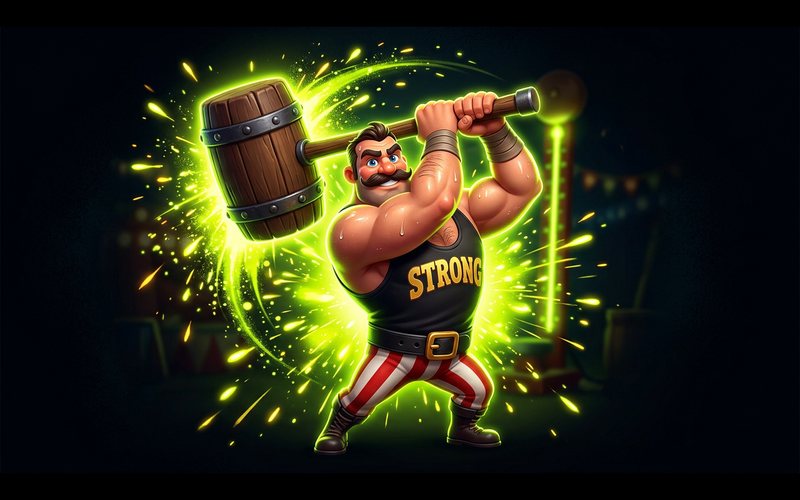 HAMMER KING
Crash · High striker
Playable demo soon
HAMMER KING
Crash · High striker
Playable demo soon
Most crash games are a line on a graph. The math is exciting; the picture isn't. Hammer King keeps the exact crash contract, a hidden crash point drawn per round, a live multiplier, cash out any moment, and wraps it in something physical: a retro carnival stage, a sliding log tower, and a strongman whose hammer strike launches the round.
The bet was that tension reads better on a body than on a curve. When the puck burns, the character slumps and facepalms. When you cash out big, he flexes. The math didn't change; the empathy did.
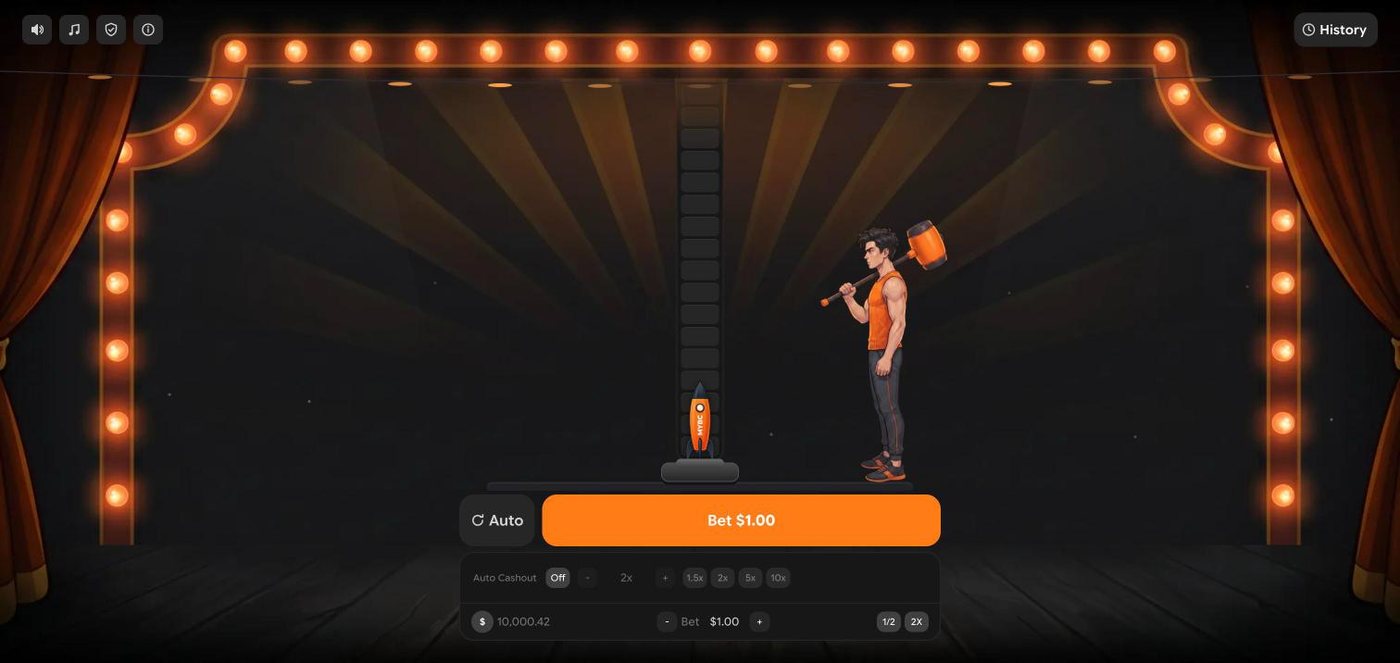
Each round draws a hidden crash point from a provably fair crash distribution (96.5% RTP configuration). The visible flight maps time to multiplier with m = e0.1733·t, so 2x lands at roughly four seconds: fast enough to feel alive, slow enough to make the cashout decision real. A turbo mode runs the same curve at 4x speed for players who want volume.
Fairness is player-checkable: every round's crash point is committed before the round starts and verifiable after it ends, with a full round history and a verification drawer in the game. Auto-cashout is resolved before the crash check in the loop, so a player who set 2.00x wins at exactly 2.00x whenever the crash point allows it. No "it busted just as I clicked" ambiguity.
If your auto target is reachable this round, you win at that exact number. Trust is the product; rounding against the player would poison it.
Cashout follows the Aviator principle: the backend is authoritative for when you cashed out and at what multiplier, and the client only renders that truth. Settling money client-side would be quicker to build and impossible to trust.
The multiplier is a puck climbing a log tower. The puck pins at 75% of the screen and the tower slides underneath it, so the sense of speed comes from the world moving, not the puck: the same trick side-scrollers use. Passing your auto-cashout marker shows a win-chance pill right at the threshold. The bust is instant: a burn effect and a sound, no slow-motion consolation.
The strongman is a sprite character generated with an AI pipeline: concept, turnaround reference, twelve pose frames with reference chaining, background removal, then heel-aligned onto a fixed canvas so every frame stands on the same ground line. Animation is state-driven: strike, release, win (pump and flex loop), lose (slump and facepalm), and the strike resolves exactly on the impact frame so the sound, the puck launch, and the hammer hit land on the same tick.
Around him: a night-carnival backdrop, a flame trail on the puck, a bell burst at launch, circus-tension background music that starts on the first gesture, and a boot screen with the MYBC mark. Feel is a budget; all of it was spent on the two moments that matter, launch and resolution.
Free rounds are supported with the same contract as the other Originals: inclusive rounds pay the full payout, exclusive rounds pay the payout minus the stake, and both are labeled in the history. Auto mode runs 10, 50, 100 or endless rounds with the same cashout rules as manual play. Everything a player can win or lose is visible in the round drawer with local verification.
The whole game is built against the production RGS crash engine's contract, cashout included, so the real-money backend wires in without touching the frontend.
 Beka Jikurishvili